Guides › Stephen King › Stephen King first editions
How to identify a Stephen King first edition
Stephen King first editions are identified differently by publisher and era: Doubleday (1974–1983) marked its firsts with a “First Edition” line and a small gutter code near the end of the book; Viking (1979–1987) with “First published in…” and the jacket price; Donald M. Grant’s Dark Tower books with “First Edition” and two prices on the flap; Putnam, the later Viking books and Scribner with a number line. It matters because the book club editions use the same jacket art and are often listed as “first editions”. Five checks settle almost every copy; then the points title by title, with what each first printing is worth today.
The five checks
- Front flap: the original price at the top (book club jackets have none).
- Copyright page: “First Edition” (Doubleday, Grant) or “First published in 19xx by…” (Viking).
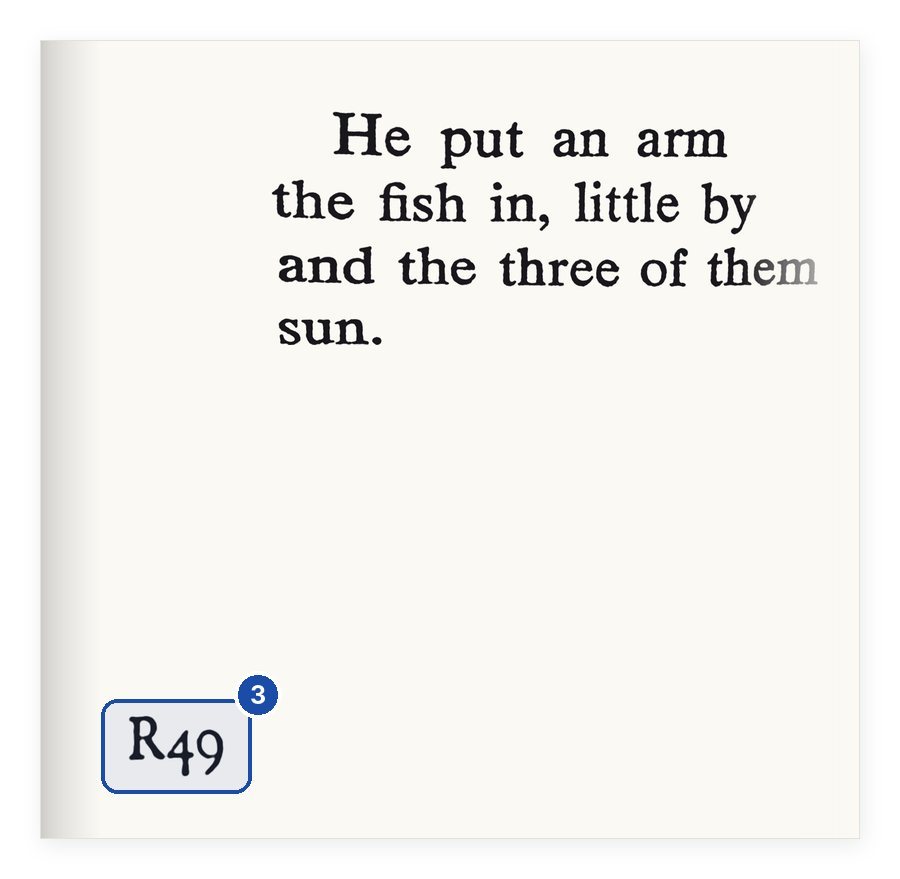
- Doubleday only: the gutter code at the foot of one of the last pages is the first printing’s (R49 on The Shining).
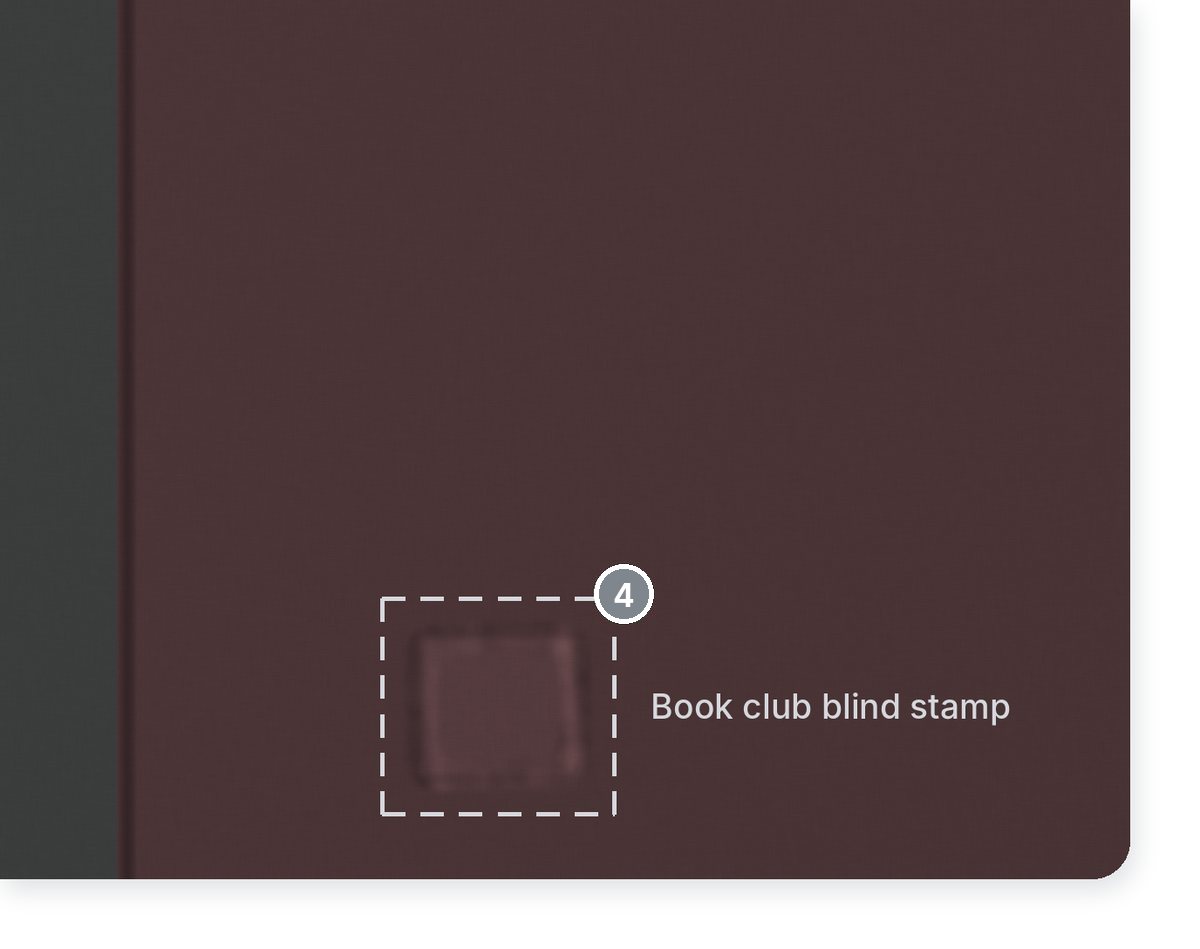
- Book club tells: a small blind stamp on the rear board, a thinner, smaller book, cheaper boards.
- Putnam (1985 on), Viking in the 1990s, Scribner: a number line that still has its 1.
1. The price on the front flap
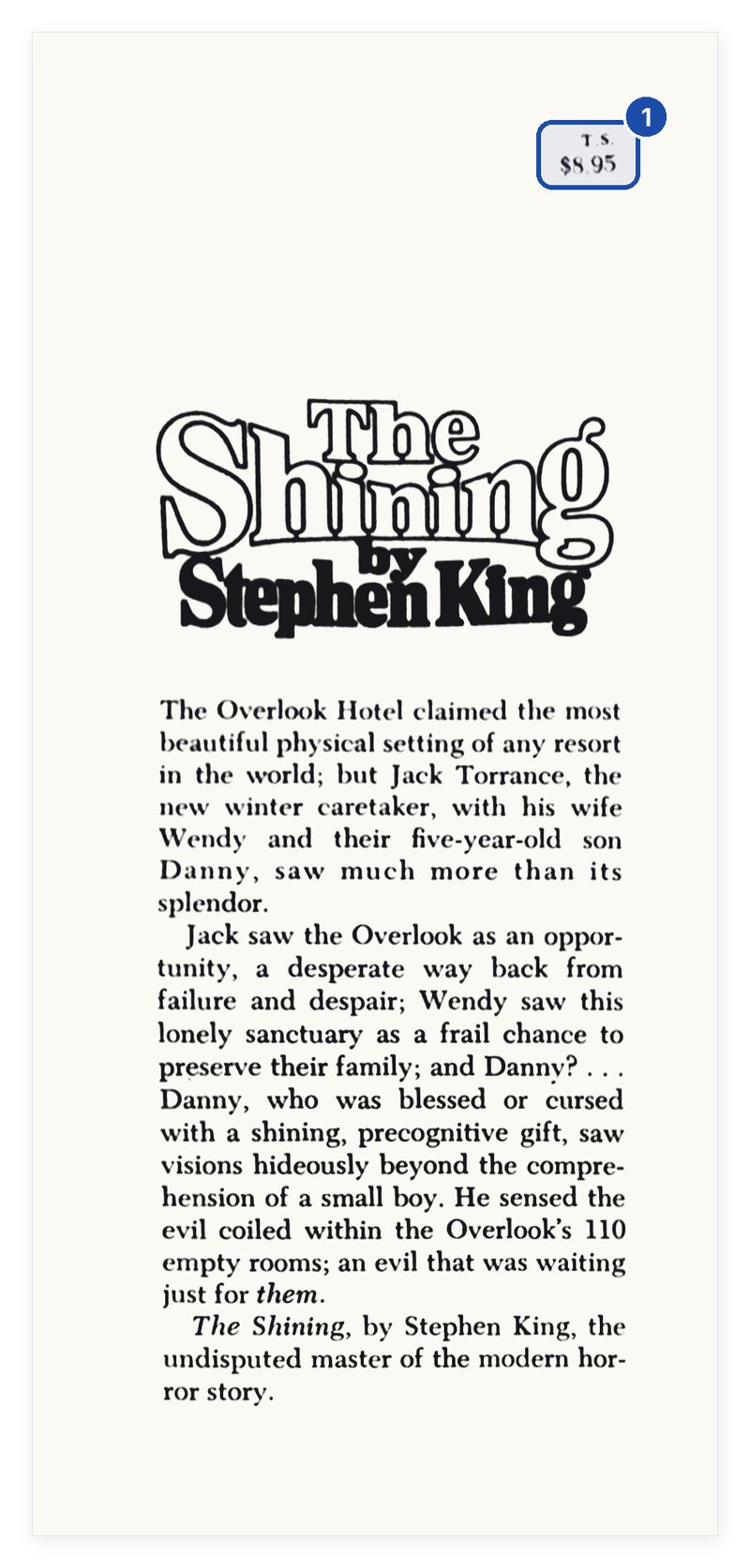
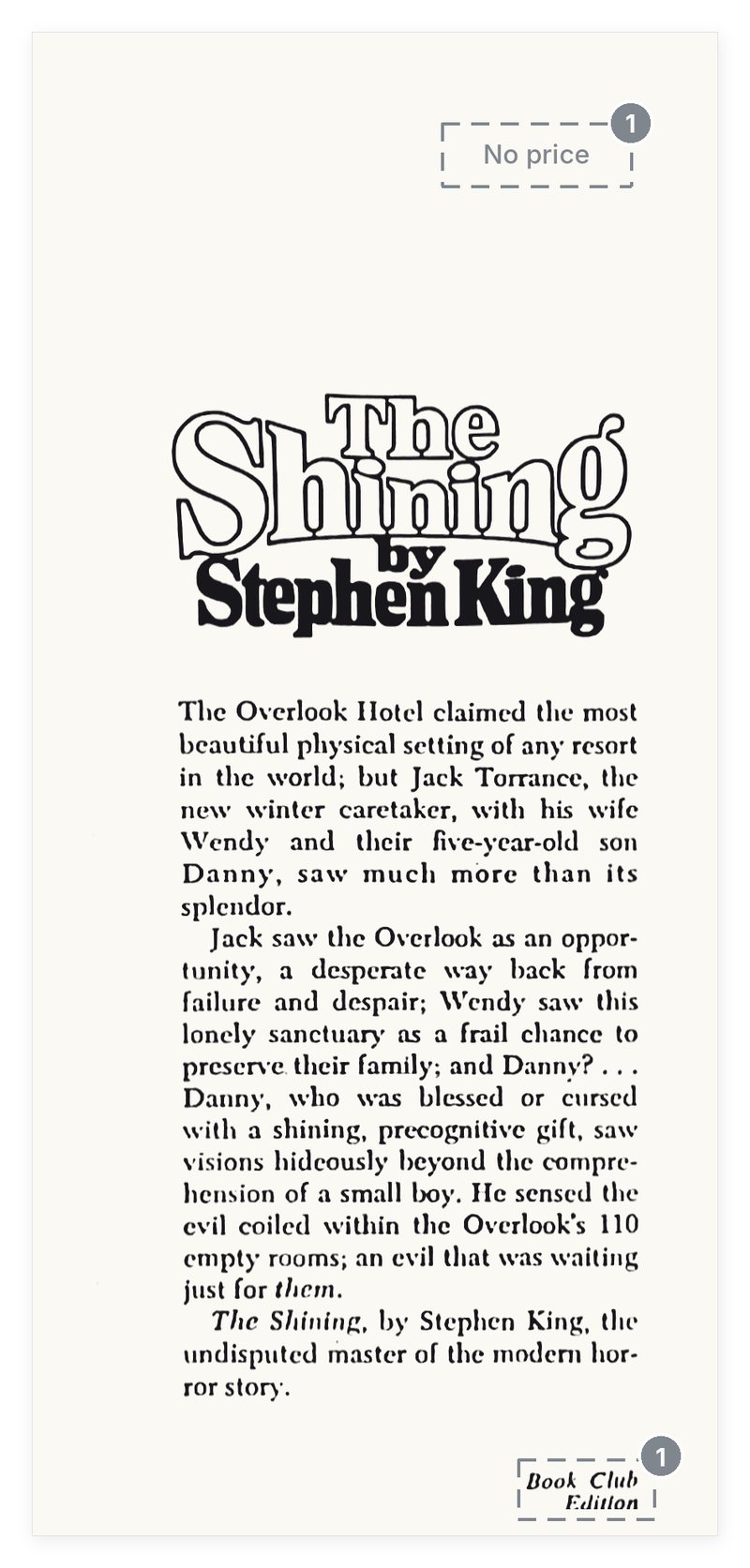
Open the jacket to the front flap. A first printing’s jacket carries the publisher’s price at the top right: $8.95 under “T.S.” on The Shining, $12.95 on The Stand, $22.95 on IT. Book club jackets have no price there, and Doubleday’s print “Book Club Edition” at the foot of the flap instead. A clipped corner removes the price and lowers the value, but a clipped first is still a first: then the copyright page and the gutter code decide.
2. The statement on the copyright page
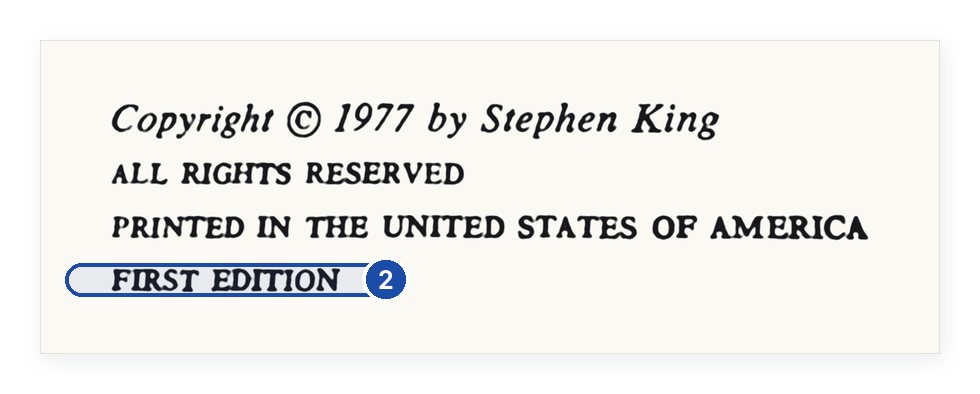
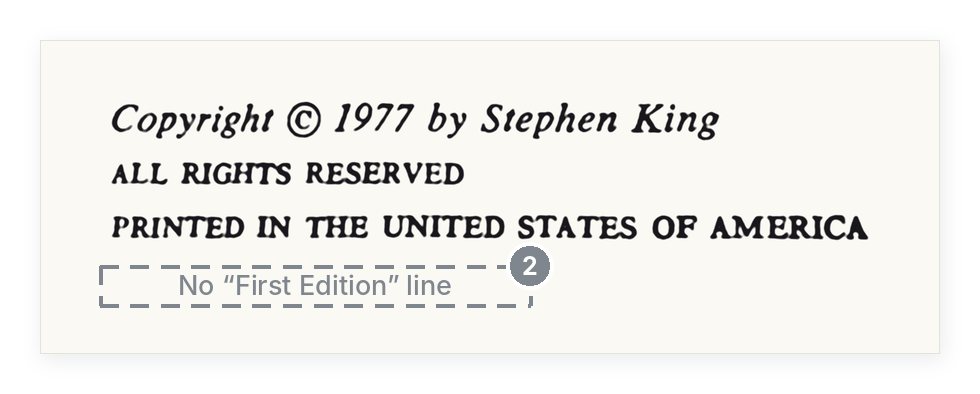
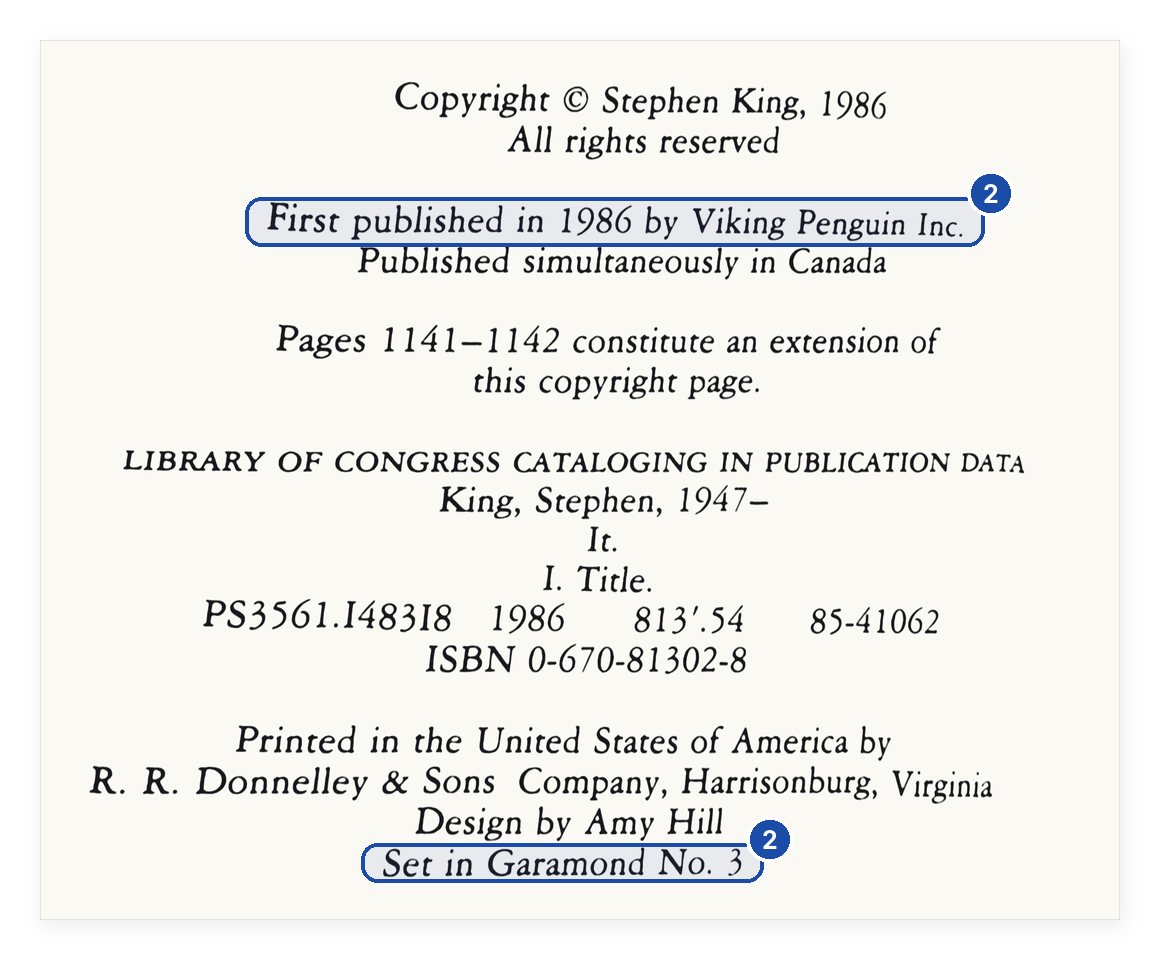
Turn to the copyright page, the back of the title page. Every Doubleday first prints “First Edition” (or “FIRST EDITION”) as the last line, under “Printed in the United States of America”. The book club copies of The Shining we compared stop at “Printed in the United States of America”: no “First Edition” line. Viking’s firsts don’t say “First Edition” at all: they read “First published in 1986 by Viking Penguin Inc.” (IT), and the edition sections below give each book’s wording.
3. The gutter code on the last pages (Doubleday)
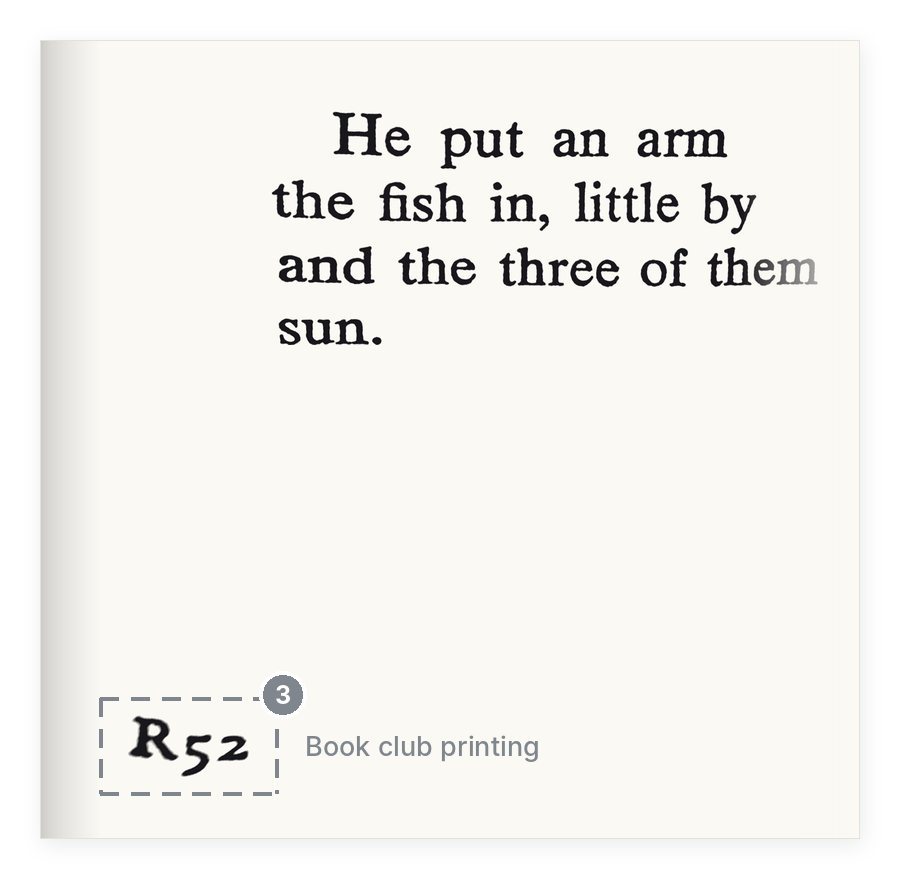
Doubleday printed a small code, a letter and a number, in the gutter (the inner margin) at the foot of a page near the end of the book. Each printing has its own, so the code dates the copy: The Shining’s first printing has R49 on page 447, the book club printing R52 on the same page. Open the book flat at the last pages and look close to the binding: the code is tiny and often half hidden in the fold. The first-printing code for each Doubleday title is in the table below.
4. Book club tells on the book itself
Take the jacket off. Many Doubleday book club copies have a small blind stamp (a little square or dot pressed without ink) near the foot of the rear board; tilt the book to the light to see it. They are also a little smaller and thinner, on cheaper paper, and the boards differ: the book club Shining we compared is bound in plain green boards, the first in tan paper boards with a black spine. No stamp proves nothing on its own, but a stamp settles it.
5. The number line (Putnam, later Viking, Scribner)
Putnam’s King books from Skeleton Crew (1985), the later Viking books and the Scribner books carry a number line on the copyright page: 1 2 3 4 5 6 7 8 9 10 on Skeleton Crew, 1 3 5 7 9 10 8 6 4 2 on Insomnia (Viking, 1994). The lowest number is the printing: a line without its 1 is a later printing, whatever else the page says. The earlier Viking books (The Dead Zone to Misery) have no number line: there the “First published in…” statement and the jacket price are the points.
Gutter codes explained
A gutter code is a printer’s batch mark: a letter and a number (later two letters and a number) printed small in the inner margin, the gutter, at the foot of a page near the end of the text. Doubleday printed them on its own printings and on the copies it printed for its book clubs, so a Doubleday King book carries one, and only the first printing carries the first-printing code.
- Where to look: the last page of text, or one of the last few. Open the book flat and look at the foot of the page, right against the binding. On Pet Sematary the 8 of Y38 often hides in the fold.
- What it says: the first-printing code for each title is below. Any other code means another printing: the book club Shining reads R52 on page 447, and a later Doubleday printing we photographed, from after Doubleday joined Bantam Doubleday Dell, reads MP1CC.
- Doubleday only: gutter codes are a Doubleday convention. For the Viking, Putnam, Grant and Scribner books, read the statement, the number line and the flap price.
| Title | First printing code | Page |
|---|---|---|
| Carrie (1974) | P6 | 199 |
| ’Salem’s Lot (1975) | Q37 | 439 |
| The Shining (1977) | R49 | 447 |
| Night Shift (1978) | S52 | 336 |
| The Stand (1978) | T39 | 823 |
| Pet Sematary (1983) | Y38 | 374 |
Codes from the first printings on BBourse, each listed on its edition page under How to identify.
Stephen King book club editions
Doubleday printed the book club copies of King’s books itself, with the same jacket art. They sold in huge numbers, which is why so many “first editions” of The Stand and The Shining turn up cheaply, and they are worth a small fraction of a first printing. The tells, in the order a collector checks them:
- No price on the front flap, and “Book Club Edition” at its foot (check 1).
- No “First Edition” line on the copyright page, on the copies we compared (check 2).
- A different gutter code: R52 instead of R49 on The Shining (check 3).
- A blind stamp on the rear board, a smaller, thinner book and cheaper boards (check 4).
A first printing in a book club jacket, or a book club book in a first-printing jacket, is a “married” copy: check both the book and the jacket.
Carrie first edition (Doubleday, 1974): P6 on page 199
First printing, unsigned, near fine: $4,745 · Signed, near fine: $8,467 · Full values by condition
King’s first book, and the most valuable King first. The first printing has “First Edition” as the last line of the copyright page, the gutter code P6 on page 199, and $5.95 at the top right of the front flap.
’Salem’s Lot first edition (Doubleday, 1975): Q37 and the “Father Cody” jacket
First printing, unsigned, near fine: $3,500 · Signed, near fine: $12,075 · Full values by condition
“First Edition” on the copyright page and Q37 in the gutter of page 439. The jacket is the hard part: the first state is priced $8.95, and first printings also come in jackets price-clipped and overprinted $7.95, or printed $7.95. The first two jacket states name “Father Cody” on the front flap, the third “Father Callahan”. The $8.95 jacket also turns up on early reprints, so the price alone doesn’t prove a first: the Q37 code does.
The Shining first edition (Doubleday, 1977): R49 on page 447
First printing, unsigned, near fine: $3,220 · Signed, near fine: $1,175 · Full values by condition
The model case, shown in the checks above: “FIRST EDITION” as the last line of the copyright page, R49 at the foot of page 447, and $8.95 under “T.S.” at the top right of the front flap. The book club edition has none of the three: no price, no statement, and R52 on page 447.
Night Shift first edition (Doubleday, 1978): S52 on page 336
First printing, unsigned, near fine: $2,300 · Full values by condition
King’s first story collection: “FIRST EDITION” as the last line of the copyright page, S52 in the gutter of page 336, and $8.95 at the top right of the front flap.
The Stand first edition (Doubleday, 1978): T39 on page 823
First printing, unsigned, near fine: $1,079 · Signed, near fine: $4,635 · Full values by condition
The copyright page reads “Copyright © 1978 by Stephen King / All Rights Reserved / Printed in the United States of America / First Edition”; the code T39 is at the foot of page 823, the last page, by the gutter; and the front flap is priced $12.95 under “T.S.”. The book club printing is everywhere and looks the same in its jacket: check the code.
Pet Sematary first edition (Doubleday, 1983): Y38 on page 374
First printing, unsigned, near fine: $163 · Signed, near fine: $3,278 · Full values by condition
“FIRST EDITION” on the copyright page; Y38 at the foot of page 374, under “February 1979–December 1982” (the 8 often sits in the binding); $15.95 at the top right of the front flap, after “P.S.”; and the code 1183 at the foot of the rear flap. The boards are black cloth with a gilt facsimile signature on the front.
The Gunslinger first edition (Donald M. Grant, 1982)
First edition, unsigned, near fine: $3,843 · Signed, near fine: $6,728 · Full values by condition
The first Dark Tower book was published by Donald M. Grant in a trade edition and a deluxe limited edition. The trade first reads “Printed in the United States of America / First Edition” and carries two ISBNs, Trade Edition and Deluxe Edition, with “Donald M. Grant, Publisher, Inc. / West Kingston, Rhode Island / 1982” at the foot. The front flap lists two prices, Trade $20.00 and Limited $60.00.
IT first edition (Viking, 1986): “First published in 1986”
First printing, unsigned, near fine: $110 · Signed, near fine: $2,566 · Full values by condition
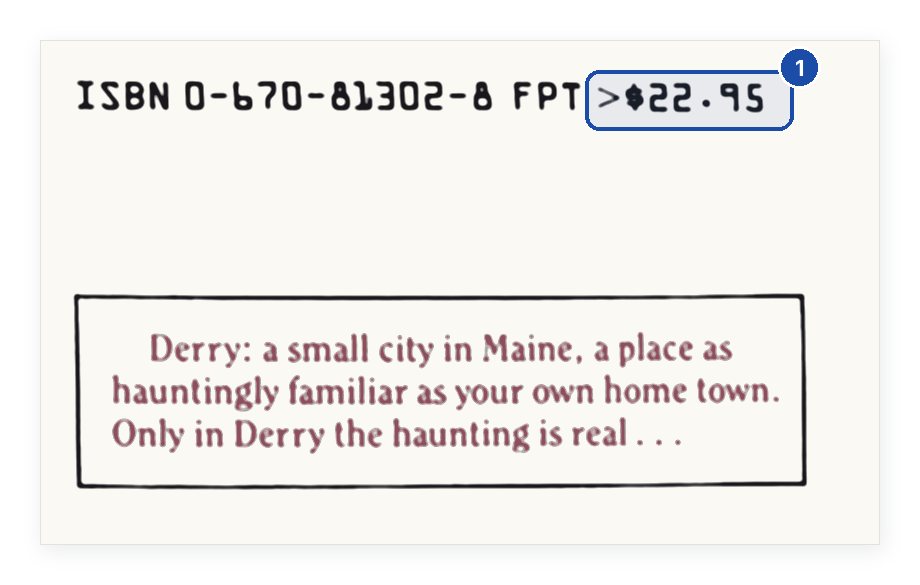
Viking marked its firsts with a statement, not a code or a number line. The first printing of IT reads “First published in 1986 by Viking Penguin Inc.” and “Published simultaneously in Canada”, and the printer block ends “Set in Garamond No. 3”. The front flap opens with the line “ISBN 0-670-81302-8 FPT >$22.95”: the price is the last item. Both images below are from our own copy.
Misery first edition (Viking, 1987)
First printing, unsigned, near fine: $34 · Signed, near fine: $3,220 · Full values by condition
The same Viking convention: “First published in 1987 by Viking Penguin Inc.” as the only printing statement, no number line, and $18.95 on the front flap. The book runs to 310 numbered pages; the jacket is by Neil Stuart.
Other Stephen King first editions
The first-printing point for each, from its edition page, where the full points and values are.
| Title | Publisher, year | The point |
|---|---|---|
| Insomnia | Viking, 1994 | “First published in 1994 by Viking Penguin…” above the number line 1 3 5 7 9 10 8 6 4 2 |
| Cujo | Viking, 1981 | “First published in 1981 by The Viking Press”, no number line; $13.95 on the flap |
| Christine | Viking, 1983 | “First published in 1983 by The Viking Press”, “Set in Linotron Garamond” |
| Firestarter | Viking, 1980 | “First published in 1980 by The Viking Press”, no number line; $13.95 on the flap |
| The Dead Zone | Viking, 1979 | “First published in 1979 by The Viking Press”, no number line; $11.95 on the flap |
| Different Seasons | Viking, 1982 | “First published in 1982 by The Viking Press”, “Published simultaneously in Canada…” |
| Skeleton Crew | Putnam, 1985 | Number line 1 2 3 4 5 6 7 8 9 10, starting at 1; $18.95 on the flap |
| The Bachman Books | NAL Books, 1985 | “First (Omnibus) Printing, October, 1985” with the number line 1 2 3 4 5 6 7 8 9 |
Doubleday first printing or book club edition? At a glance
| First edition, first printing | Book club edition | |
|---|---|---|
| Front flap | The price at the top right ($8.95 on The Shining) | No price; “Book Club Edition” at the foot |
| Copyright page | “First Edition” as the last line | No “First Edition” line |
| Gutter code | The first-printing code (R49 on The Shining) | Another code (R52 on The Shining) |
| Rear board | Plain | Often a small blind stamp |
| The book | Full size, publisher’s boards | Smaller, thinner, cheaper boards |
A Doubleday first needs the statement and the right code; the jacket needs the price. For Viking, Putnam, Grant and Scribner, read the title’s section above.
Common questions
- Is a book club edition of a Stephen King book worth anything?
- A little. Book club copies of The Stand, The Shining or Carrie usually sell for a small fraction of a first printing, because they were printed in far larger numbers. A signed book club copy is worth more than an unsigned one, but still well below a signed first.
- What is a gutter code?
- A small letter-and-number code Doubleday printed in the inner margin at the foot of a page near the end of the book. Each printing has its own: R49 on page 447 of The Shining marks the first printing, R52 the book club printing. Only Doubleday books have them.
- Do Stephen King first editions have a number line?
- Only the later ones. The Doubleday books (1974–1983) and the early Viking books (1979–1987) have none: read the “First Edition” or “First published in…” statement instead. From Skeleton Crew (Putnam, 1985), Insomnia (Viking, 1994) and the Scribner books on, a first printing’s number line still has its 1.
- How much is a signed Stephen King first edition worth?
- Much more than an unsigned copy: a signed first of The Stand or ’Salem’s Lot is worth several times the unsigned book. Each King edition’s signed and unsigned values, by condition, are on the author page. Stephen King first editions: values, signed and unsigned.
- Which Stephen King first editions are the most valuable?
- The early Doubleday books in their first printings and first-state jackets, Carrie and ’Salem’s Lot first, then The Shining, Night Shift and The Stand; and The Gunslinger from Donald M. Grant. Their current values are in each section above and on the author page. Every Stephen King first edition, most valuable first.
Guides and editions mentioned
- Stephen King first editions: values, signed and unsigned: every King edition we value, most valuable first
- How to tell if any book is a first edition: statements, number lines, book club tells and signatures, illustrated
- Signed, inscribed, bookplate or facsimile?: how to tell a real signature
All images are recreated from photographs of real copies: the IT flap and copyright page from our own copy in the BBourse collection, The Shining pages and flaps from copies photographed for sale. Printed type is taken from the photos exactly; lighting, glare, curl and wear are removed so the points read clearly.
Have a first printing? Send a few photos and get a firm offer in 2–3 days. Get an offer.